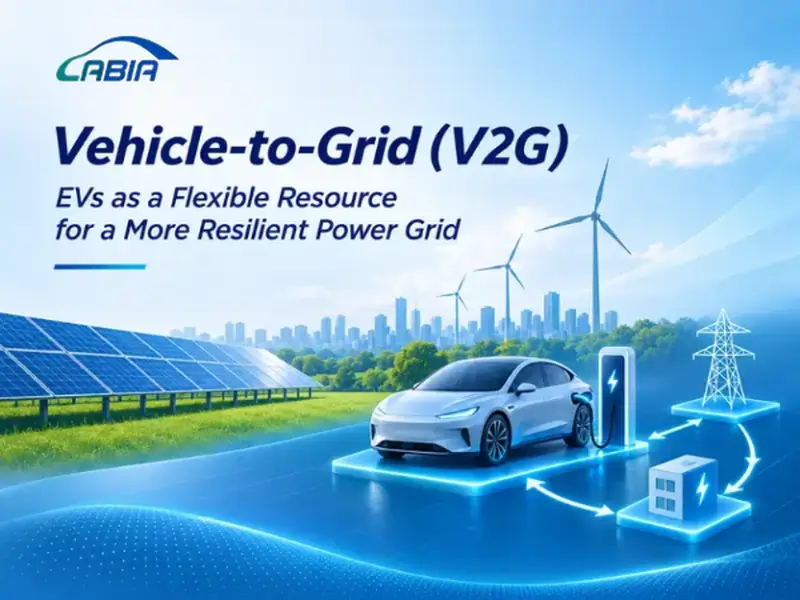
Vehicle-to-grid (V2G) technology was among the developments identified in the China Society of Automotive Engineers’ (China SAE) Top 10 Automotive Technology Trends for 2027, released during the 33rd China SAE Congress & Exhibition (SAECCE 2026) in Suzhou.
China SAE forecasts that V2G could provide daily-average reverse flexible power-regulation capability at the million-kilowatt level in 2027. This figure forecasts power capability, not electricity delivered or current installed V2G capacity.
Electric Vehicles as Energy Resources
Conventional electric-vehicle charging transfers electricity from the grid to the vehicle battery. With compatible vehicles and bidirectional charging equipment, V2G can also allow electricity to flow back to the grid.
Such systems may help manage demand peaks and variations in electricity supply, including those associated with renewable generation. But large-scale use requires compatible hardware, grid connections, battery-management controls, technical standards, and viable commercial arrangements.
Energy Storage and Electrification at SAECCE 2026
The wider relationship between automotive technology and energy systems was also raised at the conference’s opening plenary.
Uwe Dieter Grebe, Director of the Institute of Powertrains and Automotive Technology at TU Wien, discussed the influence of global energy markets on automotive powertrains. According to Sohu Auto and CCTV’s conference coverage, he emphasized the importance of electrification while acknowledging that different regions and applications may require different energy pathways.
The reports also described his discussion of storage infrastructure, including battery storage and other energy carriers. CCTV’s account highlighted the potential of vehicle-grid interaction and bidirectional charging.
What V2G Means for Battery Companies
For battery manufacturers, V2G adds operating requirements beyond those associated with vehicle propulsion alone. Battery durability, charge–discharge control, thermal performance, and system reliability must all be considered in the context of grid services.
Charging-equipment manufacturers, grid operators, energy-service providers and testing organizations also have a role in determining how widely such systems can be deployed.
The 2027 forecast places V2G among the technologies to monitor as electric vehicles become more closely linked to electricity infrastructure. Its practical development will depend on technical compatibility, market arrangements, and evidence from real-world operation.