
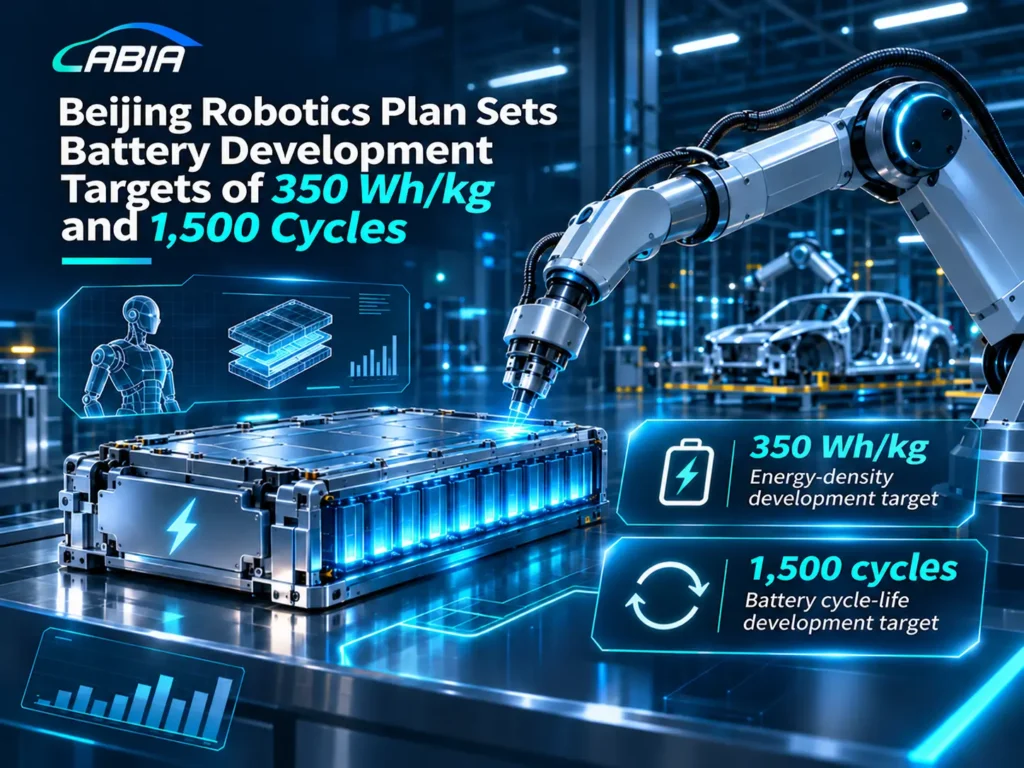
Beijing has identified high-safety batteries with an energy density of 350 Wh/kg and a cycle life of 1,500 cycles as a priority technology under its new action plan for the embodied intelligent robotics industry.
Issued by the Beijing Municipal Bureau of Economy and Information Technology on 11 November 2026, the Action Plan for the High-Quality Development of Beijing’s Embodied Intelligent Robotics Industry (2026–2028) outlines measures to advance robot technologies, strengthen manufacturing capabilities and support deployment in practical applications.
For the battery industry, the plan sets specific performance objectives for an emerging application area, along with broader requirements for robot endurance, reliability, and safety.
Battery Performance and Continuous Operation
The plan lists high-safety batteries among the key components targeted for technological advancement, together with motors, precision reducers, integrated joint modules, sensors and dexterous hands. In addition to the battery energy-density and cycle-life objectives, it targets more than four hours of battery endurance for complete robots under continuous operating conditions.
These objectives form part of a wider effort to develop robot platforms suitable for deployment at scale. Other complete-robot targets include a rated payload exceeding 40% of the robot’s own weight, mean time between failures above 2,000 hours and a design service life exceeding five years.
The battery figures are development targets under the action plan. The document does not specify battery chemistry, whether energy density is measured at cell or pack level, or the testing conditions associated with the cycle-life target.
Applications Across Industry and Services
The plan promotes robot deployment across manufacturing, logistics, commercial services, elderly care and specialized operations.
By 2028, Beijing aims to establish at least 20 benchmark industrial application scenarios, 20 service scenarios and ten specialized scenarios. It also seeks to develop at least 15 solutions suitable for deployment at scale. Industrial applications include material handling, inspection, sorting and assembly support. Service applications cover areas such as guidance, retail, security inspection and care assistance.
The plan calls for evaluation of task efficiency and investment returns, alongside mechanisms for collecting operating data and feeding it back into product development.
Relevance to the Battery Industry
The combination of battery performance targets and continuous-operation objectives identifies robotics as an application area for battery developers and system integrators to monitor.
The policy also prioritizes research into energy and power distribution safety and proposes expanded testing capabilities for robot components and complete systems. These measures place battery development within the wider context of reliable and safe robot operation. Further implementation measures and project specifications will be needed to establish detailed technical requirements and commercial opportunities.
The action plan remains valid until 31 December 2028.
Source: Beijing Municipal Bureau of Economy and Information Technology, November 11, 2026.