[Opportunities and Challenges of Power Batteries in eVTOL and Electric Aviation – Wang Ke, Battery Pack Manager, Sichuan Wofei Changkong Technology Development Co., Ltd.]
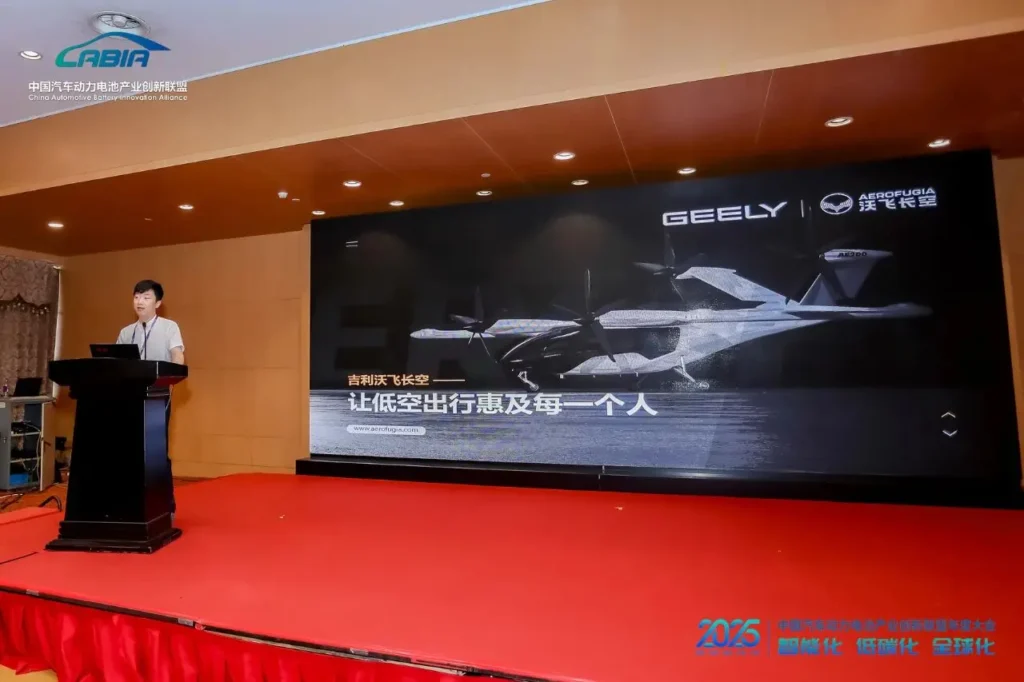
Today, on behalf of our company, I would like to report to you, the leaders, experts, and colleagues, on our company’s situation and share our insights on low-altitude economic batteries.
First, I will quickly introduce the background, as this is a topic familiar to most of you.
First, let me introduce our company. Wofei Changkong is part of Geely’s low-altitude economic sector. Geely currently has several major business segments, including its automotive sector, which has been undergoing significant consolidation. Wofei Changkong is a subsidiary of Geely Technology Group. Within Geely Technology Group, new energy, new materials, and other high-tech industries are located, including battery cell manufacturers and satellite companies. Wofei Changkong is a low-altitude economic company under Geely Technology Group. From a broader perspective, Wofei Changkong covers the entire industrial chain, from consumer drones to medium-sized industrial drones to manned eVTOL systems. We have related companies in all these sectors. The last section is about mobility. This is something most people are familiar with.
I won’t go into the details of eVTOL. This is our company’s main product. One product we’re developing is the AE200, which is unique in China because these electric motors transition from a vertical to a horizontal flight configuration.
This is a video of a completed lightweight rotor full-plane flight test.
We are also the second company in the world to conduct such a flight test. Currently, it’s in a vertical climb phase. After the vertical climb, it has entered a transition phase. The engine tilt angle is quite noticeable. In the lower left corner, you can see the engine is already performing a turning maneuver, which is now complete, finally reaching takeoff. The vertical propellers have stopped spinning. There’s a flight path diagram in the lower left corner of the video, a heart-shaped path. Below that are speed and altitude markings. eVTOL configurations are roughly divided into three types: multi-rotor, compound rotor, and lightweight rotor. The main technical challenge of lightweight rotorcraft lies in the transient control of the engine. The control algorithm and program are relatively complex. Its advantages include lighter weight, and the engine can provide both vertical and forward thrust. The aircraft in the video is currently entering a descent phase. We can see that all the vertical propellers have started operating, and the engine rotation is adjusting, gradually transitioning to a vertical position in preparation for landing.
Regarding commercial applications, the industry is converging on similar approaches, so I won’t elaborate further. Industry development forecasts are also similar to those of the previous speaker.
Currently, the industry is primarily focused on automotive companies, aviation companies, and emerging internet companies, all actively investing in eVTOL and the low-altitude economy.
Today, I will focus on the second and third parts: the new demands that eVTOL places on the battery industry. I hope to have the opportunity to collaborate with everyone in the future.
Our demand for eVTOL batteries, besides functional requirements, is particularly unique in terms of range. Currently, we need everyone’s cooperation to promote the development of our national standards. Even in Europe and America, there are no specific standards for power lithium batteries. We are basically drawing on standards from other lithium batteries, as well as small lithium batteries, to complete our test flights.
eVTOL has a typical operating condition with several major phases. Different phases place different demands on lithium batteries, especially in the final phase, the descent and stop phase after a slight turn. This phase is very different from automobiles. During descent and slight turns, and especially during vertical landing, the power requirements are particularly high. At this time, the battery’s SOC is relatively low. Automobiles typically reduce power at low SOCs to ensure battery safety. Due to this special operating condition, we require the battery to continue discharging at high power even at low SOCs. We also need to consider extreme situations. If emergency situations occur during the descent phase, requiring emergency operations, the battery requirements are even higher.
We have roughly summarized the current requirements for batteries as “three highs,” though some colleagues refer to “four highs” or “five highs”: high energy density, high power density, and high safety. These are all indispensable. There is a particularly high power requirement during the descent phase, and there may be a mid-course landing and go-around. Even during normal cruise, a 5C discharge rate must be achieved. eVTOL requires batteries with superior environmental adaptability. Currently, battery environmental adaptability is designed according to RTCA/DO-160G standards. These requirements include short-term rapid discharge at high temperatures, discharge under extreme conditions, drop impact resistance, and even explosion containment – all specific requirements outlined in DO 160G.
For eVTOL, we generally do not use a parallel-then-series approach. Instead, we employ multiple battery packs with independent power supplies. Even if one battery pack is removed, the remaining packs can still power the entire aircraft for normal flight.
Thermal runaway is a critical safety concern for both automobiles and aircraft. Two aspects demand higher standards. First, from an application perspective, we have multiple battery packs. Even if one battery pack experiences thermal runaway, the entire aircraft must still land safely. This means the aircraft must continue flying safely despite the battery pack experiencing thermal runaway. This requirement far exceeds that of electric vehicles, where a problem can be resolved by immediately stopping and landing. In contrast, if a battery pack experiences thermal runaway during flight, we must also make an emergency landing. The time and power requirements during this process are significantly higher than for electric vehicles.
Currently, our company’s overall airworthiness and operational planning timeline is as follows: This year is crucial for our company; we expect to complete the airworthiness certification process this year.
Regarding battery economics, from an eVTOL operation perspective, besides the R&D costs, the largest cost comes from the cells and battery packs. A longer battery pack lifespan results in better economics and longer replacement intervals. Frequent battery pack replacements create operational pressure.
This is a comparison of the requirements for automotive battery systems and eVTOL batteries.
Below is an overview of existing eVTOL batteries.
In general, the focus is primarily on pouch cells, especially semi-solid-state batteries, with some manufacturers achieving energy densities exceeding 400Wh.
The development direction of battery systems is likely clearer to the experts than to us; from the cell level to the pack level, there are many development directions.
The overall volume of the electric aviation industry is far less than that of the electric vehicle industry. Therefore, OEMs and many other companies hope that the electric aviation industry and the cell industry can work together to reduce costs across the industry and increase the profitability of cell manufacturers. That concludes my report. Thank you.