In 2015, China released “Made in China 2025,” which aimed to establish approximately 20 national manufacturing innovation centers by 2020. The innovation of these centers lies in their “innovation center + alliance” model. Why? Because a single innovation center is a small core with limited collaborative innovation capabilities. The alliance model expands this by building an ecosystem of collaborative industrial development. The Guolian Power Battery Research Institute met the criteria and was designated as the first national manufacturing innovation center. Minister Miao personally officiated at the center’s inauguration, and Minister Xin personally led the alliance as its guiding director. In recent years, we have carried out some work under the guidance and support of the Ministry of Industry and Information Technology.
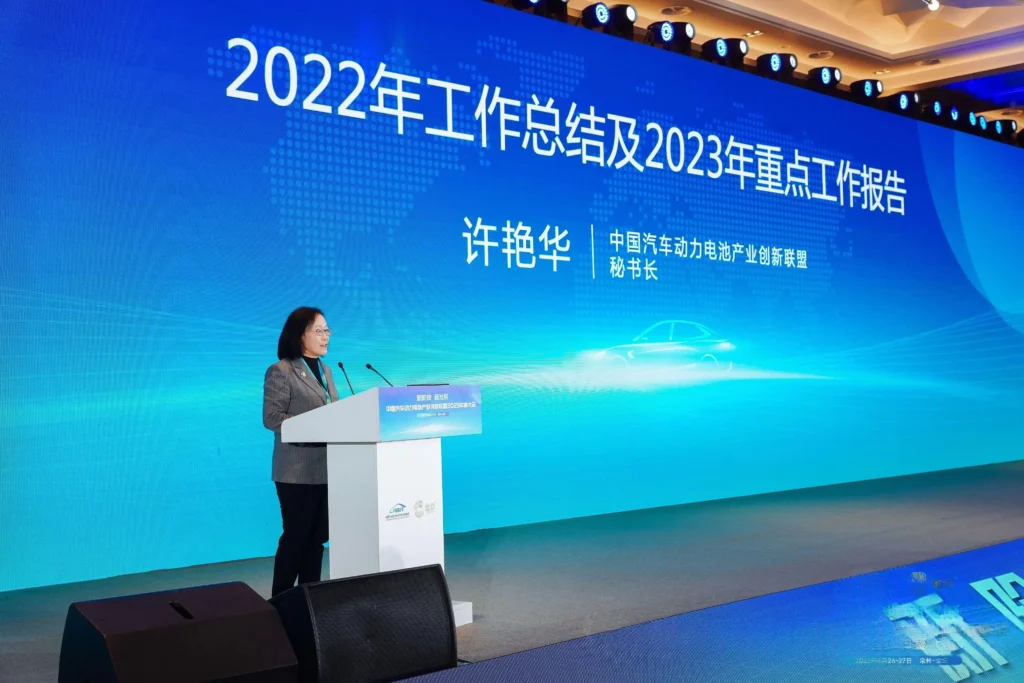
Due to the pandemic last year, we did not hold our annual meeting, so I will only briefly review some of our work. Today, I mainly want to discuss what we plan to do in 2023 and what we need the entire industry chain to work with us on.
We have also innovated in the construction of the innovation alliance. The industry chain is very long. The battery industry is not only a large sector, but its supply chain is also very long, encompassing materials, cells, systems, equipment, recycling, and more. We designed an alliance secretariat and selected leading companies in specific sub-sectors to support the alliance’s work through branch meetings.
There were initially eight subcommittees. Last year, the Recycling Subcommittee underwent a leadership change, with GEM Co., Ltd. becoming the chair unit. A Solid-State Battery Subcommittee was also added, reflecting the development trend of solid-state batteries, with the Institute of Physics, Chinese Academy of Sciences, serving as the chair unit. Some have asked if we should also establish a Sodium Battery Subcommittee now that sodium batteries exist. Opinions on this are divided, but this year we will consult with existing relevant subcommittees and several battery companies before deciding whether to establish a Sodium Battery Subcommittee.
In short, we have played a significant role in conducting industry research. Our work is based on extensive surveys, relying on the various subcommittees. We seek solutions by conducting surveys at companies, which has been very effective and forms the foundation for our active work over the past two years.
We have also facilitated industry technology exchanges. For example, we have organized discussions on sodium batteries, a topic of great interest. Recycling is also a hot topic, with a special discussion held on August 3rd last year. Safety issues are another area of discussion, but I won’t go into detail here.
Data Statistics: The Battery Alliance’s data release serves the entire industry, including the National Bureau of Statistics and all industry players. We currently have the task of compiling and releasing data on the four main battery materials, and we hope to receive support from companies within the industry.
Standards Research and Development: We participate in the formulation of national and industry standards, and also actively participate in the development of group standards.
Industry Exchange: As an industry organization, the Alliance co-hosted a battery-themed session with the China Society of Automotive Engineers, the organizer of the World New Energy Vehicle Congress. We actively participated in the World Power Battery Congress organized by the Equipment Center of the Ministry of Industry and Information Technology, and selected and released a top 20 list.
Due to the impact or inspiration of the pandemic, face-to-face meetings were inconvenient, so we established online exchanges, inviting experts and scholars to give lectures and share many new technologies, materials, and processes. The results have been very positive.
Key Tasks of the Innovation Alliance in 2023
I. Research on Carbon Footprint Accounting Methods and Construction of an Industry Public Service Platform
We have already conducted some basic research, starting last year, such as in-depth research on the European Battery Act, including its impact on us and how to address it. Based on this, we launched a project this year to build a carbon platform. Companies are currently quite anxious, whether they are materials companies or battery companies. OEMs, especially international ones, have very high requirements for this. Everyone has their own methods, but the problem is that they are not standardized and lack authority. Given this situation, our first task is to establish a carbon footprint calculation method, i.e., a standard. We already have a plan for this. Simultaneously, we need to build a carbon management platform. Based on this platform,
we need to collaborate with upstream and downstream partners to collect data and provide carbon footprint certification services. Finally, we need to promote international mutual recognition of carbon footprint certification. This work is challenging, but we will work together to push it forward.
II. Promoting the Standardization of Power Battery Cell Specifications and Dimensions
Here, we would like to remind everyone that some people say the reason there are so many battery specifications is because battery specifications have also been patented. We believe that if everyone uses the same specifications, a difference of two or three millimeters, or even less than one centimeter, becomes a patent that distinguishes us from others. This makes it impossible for us to use standardized battery specifications. This is a very important task for us, and it requires the participation of all companies in the industry.
III. Promoting the Establishment of a Closed-Loop System from Recycling to Reuse
We will continue to promote the design concept of easily manufactured and recyclable power batteries, and organize research to propose specific suggestions on manufacturing and recycling of product design elements, processes, and related auxiliary materials, for enterprises to refer to in their development and production.
We need to study how to standardize the source market mechanism for retired battery recycling. There are many documents on this. However, many issues remain. Originally, it was about the entire vehicle; later, through research, we explored whether data could be integrated between the entire vehicle and battery systems. Some battery companies have stated they will handle production, recycling, and reuse. This matter still needs careful discussion today because it also involves government management issues.
We need to study the main scenarios for the tiered utilization of retired batteries. Currently, everything is readily available, but it is still necessary to regulate the conditions for the large-scale use of tiered batteries from a safety perspective. There are indeed safety issues, as well as other problems. We need to study the standardized conditions for low-carbon and efficient production during resource recycling. We need to strengthen the research and development of technical standards for retired battery residual energy testing, residual value assessment, tiered utilization, and safety management. The Battery Alliance estimates that by 2025, there may be 135 GWh of retired batteries, equivalent to approximately 3 million vehicle batteries being retired.
IV. Research and Early Warning on Intellectual Property Risks in Power Batteries and Key Materials
We have had lawsuits in the lithium iron phosphate era, and in the ternary lithium era, there have been instances of companies trying to exploit us. Indeed, our entire industry lacked a complete management system in the past, and some companies may not have paid enough attention. For example, some foreign companies have already applied for and had their patents approved. We must establish an intellectual property system to protect our own intellectual property rights while also preventing infringement. This year, the Innovation Alliance plans to establish an Intellectual Property Professional Committee. Since the China Automotive Technology and Research Center (CATARC) has a platform for intellectual property management, and our alliance also has one, a tripartite committee will be established, bringing together industry representatives, companies, and experts to systematically review the domestic and international patent situation. We also need to accelerate the systematization of our own intellectual property into a database to better protect our intellectual property.
V. Organizing and Conducting Research on the Development Framework of the Power Battery Industry in 2035
Our battery industry has reached this stage. Furthermore, the current environment is particularly complex. Besides the European Battery Law, there is also the US Inflation Reduction Act. To catch up with China, both Europe and Japan have formulated new rounds of national battery strategies. Now, facing high-quality development and low-carbon development, and aiming for effective, sustainable, and healthy growth, we face many challenges. There are many things we need to understand, research, and implement. Therefore, this year we plan to launch a research report, potentially collaborating with relevant industry companies. We will also organize major industry players to participate in this framework research. The goal is to release the research results in September of this year. Importantly, the report will focus on the policy support needed for the battery industry’s development by 2035, which will also be addressed in the research report.
The eight sub-committees have provided strong support for the Alliance Secretariat’s work. The five key tasks mentioned earlier require the support of each sub-committee. At the same time, each sub-committee also has its own tasks. For example, the System Sub-committee is working on achieving complete self-sufficiency in BMS; the Battery Materials Sub-committee is committed to presenting material data; and the Solid-State Battery Sub-committee aims to leverage its platform to conduct more practical and effective collaborative development work in solid-state batteries.
We hope that industry companies and relevant departments will provide us with more support and guidance. Thank you!