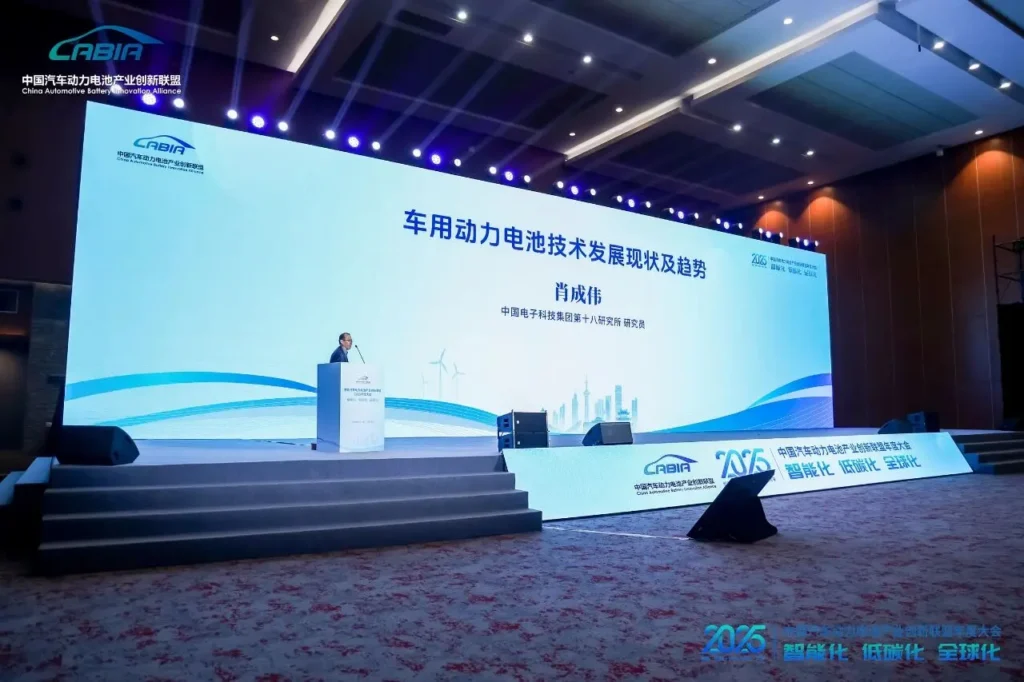
[Current Status and Trends of Automotive Power Battery Technology Development – Xiao Chengwei, Researcher at the 18th Research Institute of China Electronics Technology Group Corporation]
It is a pleasure to participate in the alliance’s annual conference. The experts before me have given excellent reports on solid-state batteries, covering aspects such as battery technology, manufacturing processes, materials, and simulation. Today, I will share my own understanding and views on the power battery industry and technology, focusing primarily on solid-state batteries.
Regarding the number of vehicles using these batteries, various institutions have predicted this year that it will reach approximately 14 to 16 million vehicles. Over the past decade, China has consistently ranked first globally in both vehicle and battery production, holding a market share of 60-70%. Even by 2035, all participating R&D institutions and battery companies in China will play a significant role in the global development of new energy vehicles, and more broadly, will act as a guide. The core component is the battery. Originally, it was mainly liquid-based, but now everyone is gradually working on solid-state batteries, including hybrid and all-solid-state batteries. This involves materials, processes, equipment, testing, evaluation, and simulation analysis. The performance indicators we are setting are increasing year by year. Under these circumstances, the pressure on both R&D institutions and industrialization companies will become increasingly greater, because our indicators are increasing year by year. The energy density of liquid batteries has increased from 400 Wh/kg to 500, 600 Wh/kg, and even reached 700 Wh/kg. The future target may be 800 Wh/kg. Let’s list the power battery technology routes, mainly lithium-based. We can see that we are currently working on these routes for both R&D and industrialization. We started doing research and industrialization more than 20 years ago. Now we are doing research on new technologies, which will also be industrialized in the near future. From liquid lithium iron phosphate to liquid ternary lithium, then moving up to solid-liquid hybrids, all-solid-state batteries, and electrochemical systems like lithium-sulfur and lithium-air, the packaging forms are quite diverse. In China, prismatic cells are currently the dominant form, but I believe large cylindrical cells will have significant growth potential in the future. Pouch cells, however, still have a relatively low market share. Currently, our solid-liquid hybrid and all-solid-state batteries are primarily pouch cells, mainly because they offer better constraint control. From a development perspective, I believe that for solid-liquid hybrid batteries, we should still aim for prismatic or cylindrical shapes, as these are better for system integration. We also hope to achieve all-solid-state batteries, but this presents significant technical challenges. For the foreseeable future, pouch cells will remain the primary choice. As you can see, our mass-produced lithium iron phosphate batteries generally achieve 180-190 Wh/kg, with even higher figures (~210 Wh/kg) in the laboratory. Both short-blade and long-blade forms are already in mass production. Cylindrical batteries: 280 Wh/kg already industrialized, ~320 Wh/kg expected to be applied in specific scenarios this year. Through structural innovations (such as CTB, CTP, etc.), the volumetric/mass energy density of battery packs can be further improved, achieving integration with vehicle bodies and lightweighting.
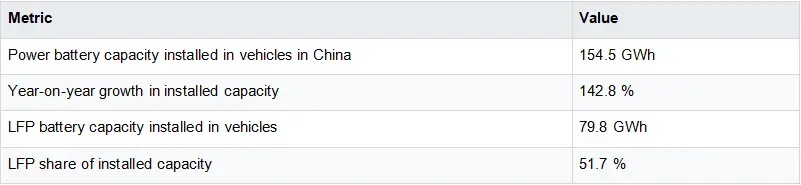
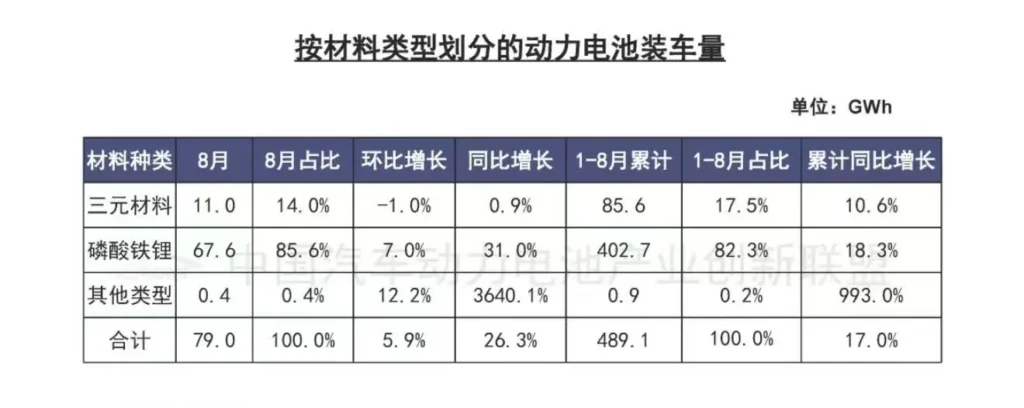
Here, I’d like to add something: when we started supporting lithium iron phosphate batteries during the 11th Five-Year Plan period, we believed its ceiling was 140 Wh/kg. Now, our mass production can basically achieve 190 Wh/kg, an increase of about 50%. This type of battery currently accounts for 70% of the Chinese market share. From January to May this year (May statistics are not available), it accounted for approximately 80% of the market share. Why is this? Consider this: we’ve achieved a well-integrated system with 190 Wh/kg, and multiplying that by a factor of 0.8, we can essentially reach 160 Wh/kg. It boasts excellent cycle life, high safety, and very low cost. While there are some issues at low temperatures, these are resolved through rapid heating technology. Now consider ternary lithium batteries. Even at 300 Wh/kg, considering safety and thermal management after runaway, we might only achieve a 70% reduction in the packing factor, resulting in around 210 Wh/kg, roughly at the 200 level. The advantage doesn’t seem significant. Furthermore, many believe lithium iron phosphate batteries still have room for improvement. Currently, high-compaction lithium iron phosphate batteries are achieving 2.6 g/cm³, with the potential to challenge 2.7-2.8 g/cm³ in the future. In terms of g/cm³, if we combine graphite and silicon in a composite anode, with a silicon content of slightly over 10%, this combination could potentially achieve a technical target of 240Wh/kg for lithium iron phosphate (LFP) batteries. Of course, considering the specific capacity and voltage platform of LFP batteries, we can blend them with lithium manganese iron phosphate (MFP), which could further improve energy density. If we then achieve a packing factor of 0.8, it can essentially compete head-on with liquid ternary lithium batteries.
Why is the proportion of ternary lithium batteries gradually decreasing? In other words, the energy density of current ternary lithium battery packs is insufficient to compete with the performance of lithium iron phosphate battery packs. This is my first point, and I think it’s also the next step for ternary lithium battery development in the near future. This brings us back to what we’re discussing now: why are we developing solid-state batteries, including solid-liquid hybrid and all-solid-state batteries? From a battery density perspective, we must differentiate ourselves from lithium iron phosphate batteries. Current specifications are around 350-360 mAh/L. With solid-liquid hybrid batteries, multiplying this by 0.7 can achieve approximately 250-260 mAh/L, a 20% increase. This demonstrates a competitive advantage. Where does this advantage lie? For the same energy, smaller size, lighter weight, lower energy consumption per 100 kilometers, and a lower carbon footprint, in line with national emission requirements. This, I believe, is the starting point and ultimate goal of our solid-state battery development.
Why are we focusing on solid-liquid hybrid batteries first? Solid-liquid hybrid batteries are essentially compatible with all current liquid lithium-ion battery processes and equipment, which I believe provides strong support for their development. Personally, I don’t think solid-liquid hybrid batteries are a transitional state; rather, they represent a long growth potential between liquid and all-solid-state batteries. This is because, as we’ve discussed, many key technical issues remain unresolved with all-solid-state batteries, and the cost is currently at least 5-10 times higher for liquid batteries. Therefore, this is the starting point and ultimate goal of our solid-state battery development. Based on this, everyone is now investing heavily—whether it’s national planning, basic research by research institutions, or industrialization by companies. Many companies are working on the four types of solid electrolytes mentioned earlier, whether we’re developing solid-liquid hybrids or all-solid-state batteries.
As mentioned earlier, solid-liquid hybrid batteries provide a good bridge between liquid and all-solid-state batteries, and we have a long development space. However, we need to find suitable application scenarios. In what types of vehicles can we effectively utilize solid-liquid hybrid batteries? This is something that companies developing solid-liquid hybrid products should focus on and work with customers or OEMs on. I think for applications in mid-to-high-end models, considering safety, I should first promote it in controllable application areas like ride-hailing services. After sufficient validation, we can then reduce costs through economies of scale and expand to other vehicle models. This is my view on the development of solid-liquid hybrid batteries, including my view on the development of lithium iron phosphate batteries.
As for all-solid-state batteries, this is currently a key area of government support and a focal point of competition among companies. Currently, the material systems are basically based on electrolytes. My personal view on all-solid-state batteries is that polymer composites and solid-liquid hybrids are largely compatible with each other in terms of process equipment and production processes. Therefore, they will be prioritized for industrialization. This is my personal opinion.
For sulfides, I think it will take a relatively long time because polymer composites can better solve interface problems, while sulfides require a lot of fundamental work. My own view is that to achieve a good interface in sulfides, a liquid needs to be added. This liquid could be an ionic liquid or other low-volatility liquid. In other words, when defining an all-solid-state battery, even under heating, the weight loss should be very low. Under these conditions, I think a significant performance improvement can be achieved for the sulfide system.
Regarding system integration with polymer composites, it’s basically similar to liquid systems. The constraints are essentially the same as in liquid systems. However, the constraints on sulfides are much higher, requiring 20-30 MPa or even higher, possibly even more. Our goal is to achieve 3-5 MPa or even lower. Even under these circumstances, as long as we apply a relatively large constraint, the grouping coefficient after system integration will be low. Therefore, the advantages of this type of system integration may not be fully realized. So, my view on this type of all-solid-state battery is that polymer composites will be prioritized for industrialization and mass production application and verification. Sulfide-based batteries, I think, will still require some time. Regarding the supporting progress mentioned by everyone, I think the target for 2027 will be roughly the same, with a target of approximately 400Wh/kg. This can proceed from small-scale testing to pilot-scale testing, and finally to large-scale production. Of course, cost is still a very core issue. I think cost reduction requires technological innovation and increased scale; these two must be closely combined.
Regarding safety, let me share some of my thoughts. For all-solid-state batteries, because they use solid-state electrolytes, including solid-liquid hybrids, the electrolyte content is reduced. This increases the thermal runaway temperature. For example, liquid ternary batteries are around 180°C, liquid lithium iron phosphate batteries around 220°C, solid-liquid hybrids around 250-260°C, and all-solid-state batteries around 300°C. In this situation, we have a large safety monitoring redundancy. We don’t necessarily want to use the battery to this temperature and cause thermal runaway. Because the thermal runaway temperature of all-solid-state batteries is higher, we have a much larger margin of safety to monitor its operating temperature in the event of thermal runaway.
Therefore, in this way, all-solid-state batteries demonstrate a significant improvement in safety compared to liquid batteries during use. The increased redundancy in thermal management and monitoring enhances the safety of all-solid-state batteries. Here are some typical companies and products, such as our solid-liquid hybrid battery, like Weilan’s 110Ah solid-liquid hybrid battery, which uses an in-situ curing process. A 150 kWh battery was used in a NIO ET7 and drove 1000 kilometers, providing an excellent demonstration.
Another example is Professor Xu’s work on Ganfeng Lithium’s high-nickel and silicon-carbon anode batteries. Ganfeng, using lithium metal anodes, is also achieving 400Wh/kg, producing similar solid-liquid hybrid batteries, which are now being implemented in automotive applications.
Let’s talk about sodium-ion batteries, which are currently a hot topic and everyone is working on industrialization. However, many bottlenecks remain. Personally, I think sodium-ion batteries still have a promising future. Firstly, they can replace lead-acid batteries in mild/micro-hybrid systems as a start-stop battery, suitable for both passenger and commercial vehicles. Secondly, Professor Hu from Zhongke Haina, a physics researcher, has developed a 165Wh/kg sodium-ion battery for heavy trucks. He calculated that it can compete with lithium iron phosphate batteries. Logically, this seems reasonable, but from a performance perspective, further improvements are needed. How do we improve performance? We still need to move towards solid-state technology, whether it’s semi-solid or all-solid. The Institute of Physics has undertaken projects to further improve sodium-ion performance and develop new technologies. Our goal, after solidification, is to achieve 200Wh/kg or even higher. We can achieve this by using an oxide cathode paired with a sodium alloy anode. From a computational perspective, I think it’s feasible. The key is whether its cycle life, rate capability, safety, low-temperature performance, etc., can meet the requirements of liquid-state technology. This is how the new system, specifically nano-ions, can achieve better industrial applications. There’s a new system for lithium-sulfur batteries, and they’re also proposing a solid-state concept. The question is whether solid-state technology can suppress or even eliminate polysulfide shuttling. Is it possible to achieve a 600Wh/kg target? We’ve also proposed 500 cycles. After discussing this with everyone, I think it’s possible, although many technical problems still need to be solved. Another area of basic research is lithium-air batteries. Is it possible to challenge a 800Wh/kg target? This is also a very good area and direction for basic research. Finally, let’s see… So, we work on solid-liquid hybrids and all-solid-state batteries. Regarding all-solid-state batteries, the industry has organized discussions and, according to institutional requirements, we’ve developed a group standard. We need a standard for judging all-solid-state batteries. This has been a hot topic online recently, with much discussion, and the consensus is that heating at 120°C in a vacuum for 6 hours results in a weight loss rate of ≤1%. I’ve communicated with many companies working on solid-liquid hybrids, and I believe this indicator is achievable; in fact, we’ve achieved even lower levels. We also achieve this indicator with polymer composites without any problems, and our sulfide-based batteries are even better.
From a developmental perspective, the mainstream technological direction for high-energy-density batteries is from liquid to solid, to solid-liquid hybrids, and finally to all-solid-state. Of course, we don’t rule out working on liquid-based solutions. As mentioned earlier, if we develop flame-retardant, high-safety electrolytes, why can’t we use them? Of course we can. If we can achieve 700Wh/kg, and it’s still liquid with good safety, then of course we can do it. However, from a technological standpoint, solid-state is still the mainstream, although we won’t abandon liquid-based solutions.
Finally, let’s talk about this roadmap. The final draft was reviewed on May 8th, and it will be released at the Society’s annual meeting and the World New Energy Vehicle Congress in Hainan later this year. I’ll just introduce the battery aspect. The battery content includes energy-type power batteries, energy-power balanced batteries, and power-type batteries, encompassing materials, battery system integration, system integration, battery manufacturing, recycling and reuse, R&D tools, testing and standards systems, and also carbon footprint and carbon emissions. The entire roadmap is designed for this purpose.