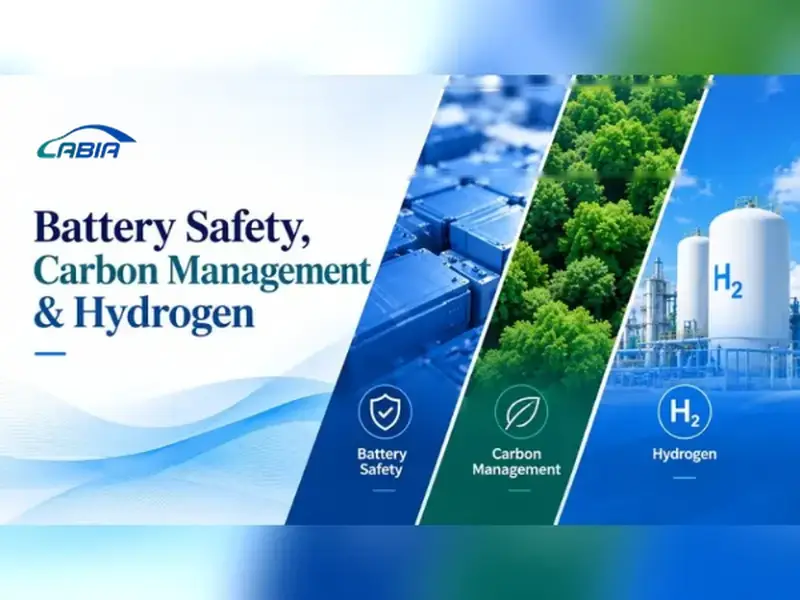
China’s latest industry updates include a July 2027 battery safety deadline, new industrial carbon-management targets, and four-year hydrogen pilots. This roundup also covers regulators’ expectations for vehicle testing and a heavy-duty battery-swapping announcement.
1. Battery Safety and Vehicle Testing
China has published GB 36672-2026, the mandatory safety standard for lithium-ion batteries used in electric motorcycles and electric mopeds. Issued on 28 September 2026, it takes effect on 1 July 2027, replacing the recommended standard GB/T 36672-2018. Manufacturers and testing organisations will need to review their products and testing arrangements ahead of implementation. std.sacinfo.org.cn
Separately, officials from four government bodies met with more than 30 major automakers on 15 October to discuss product safety and a draft notice on vehicle design and testing. Regulators called for stronger safety assessments, more thorough testing and better supply chain controls. They also urged manufacturers to explain the operating limits of vehicle functions and avoid misleading or exaggerated marketing claims. The notice discussed at the meeting was still a consultation draft.
2. Carbon Management and Clean Transport Policy
The Ministry of Industry and Information Technology (MIIT) has released a 2026–2030 plan to strengthen management of both total carbon emissions and carbon intensity across industry and information technology.
By 2030, the plan calls for around 400 carbon-footprint accounting standards for key industrial products. It also targets a reduction of at least 17% in carbon dioxide emissions per unit of industrial value added, compared with 2025, for industrial enterprises above the designated size. This is an emissions-intensity target, rather than a reduction in total emissions. The measures apply across industry and cover corporate carbon management, industrial parks, project assessments, and product carbon footprints.
In clean transport, China has approved four-year hydrogen application pilots across five city clusters. The programme combines industrial hydrogen applications with fuel-cell vehicle deployment and refuelling infrastructure. Management rules issued in October establish oversight of implementation, performance, and public funding, with assessments informing central government incentive funding.
3. Heavy-Duty Battery Swapping: Market Update
On 20 October, CATL introduced its Tianxing II dual-battery solution for heavy-duty trucks, reporting initial agreements covering 13,000 vehicles. The design combines two independently operating, complementary battery systems within a battery-swapping model. The reported figure refers to signed agreements, rather than completed vehicle deliveries.