
Structured insights on China’s battery market — from monthly data to policy changes, supply chain maps and custom research.

Production, sales, installation and export figures from the Alliance’s monthly series, translated in English with the scope, the period and the publishing body attached to each figure. Includes the LFP and ternary split and the year-on-year basis used.

Changes to GB standards and to the IEC work China takes part in; battery passport, carbon-footprint accounting and CBAM as they apply to batteries exported from China. Each item is dated and linked to the issuing body.
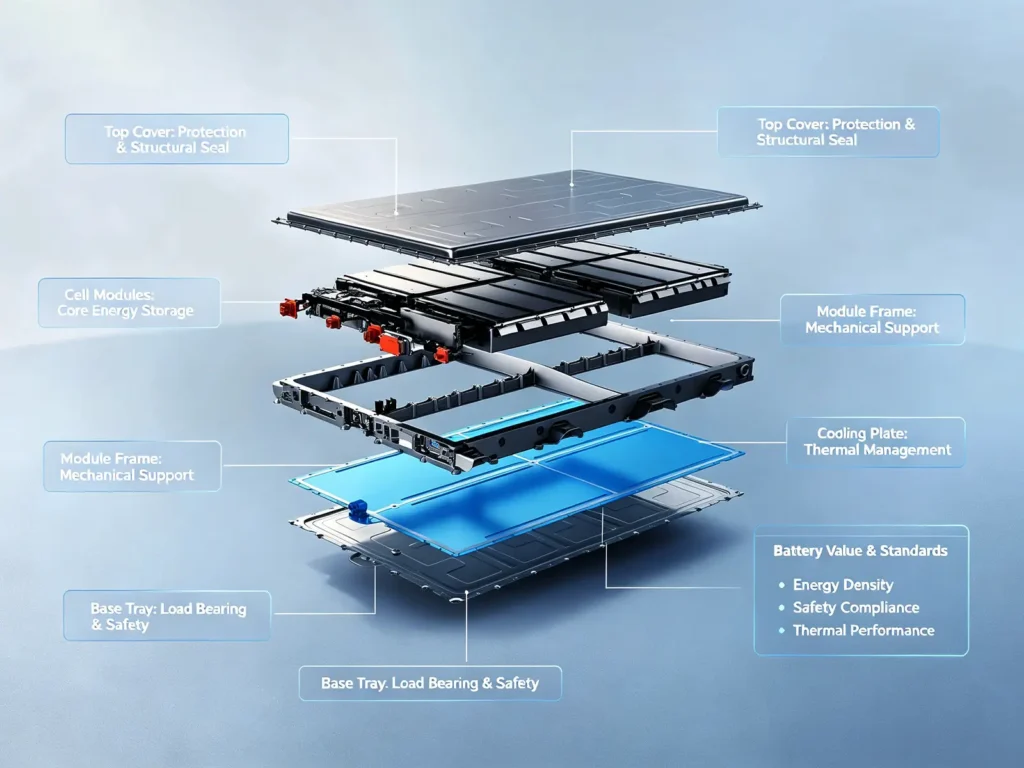
The six segments, the types of organizations operating in each, and where the segment boundaries sit for the application you name.

You send a list of questions. We answer them in writing and mark each answer as sourced, partially sourced, or not established from public records.
Briefings are built on the monthly series published by the China Automotive Battery Innovation Alliance: production, sales and export volumes for power and energy-storage batteries, and installation volumes for vehicles produced in China. Every figure carries its scope, its period and its publishing body. Where a headline figure combines power and energy-storage batteries, we say so.
+40.4% YoY
Battery capacity installed in vehicles produced in China. Excludes exported cells and energy-storage batteries. LFP 625.3 GWh (81.2%); ternary 144.1 GWh (18.7%); other chemistries 0.3 GWh (under 0.1%).
+12.0% YoY
Same measure. LFP 272.0 GWh (81.0%); ternary 63.4 GWh (18.9%); other chemistries 0.2 GWh (0.1%).
+41.9% YoY
Power battery exports only. The headline export figure of 305.0 GWh for the same period covers power and energy-storage batteries combined.
These are examples, not a fixed menu. If your question is not here, send it — the custom question set exists for exactly that.
Write to us, or fill in the form below. Your message will be sent to a member of our team, not a shared inbox.
China Battery Automotive Innovation Alliance(Cabia)——International Cooperation Committee(ICC) is the international-cooperation body of NGO. The Alliance was founded in 2016 and operates under the guidance of the Equipment Industry Division I of China’s Ministry of Industry and Information Technology.